
Revolut
Building a Global Financial Super‑App
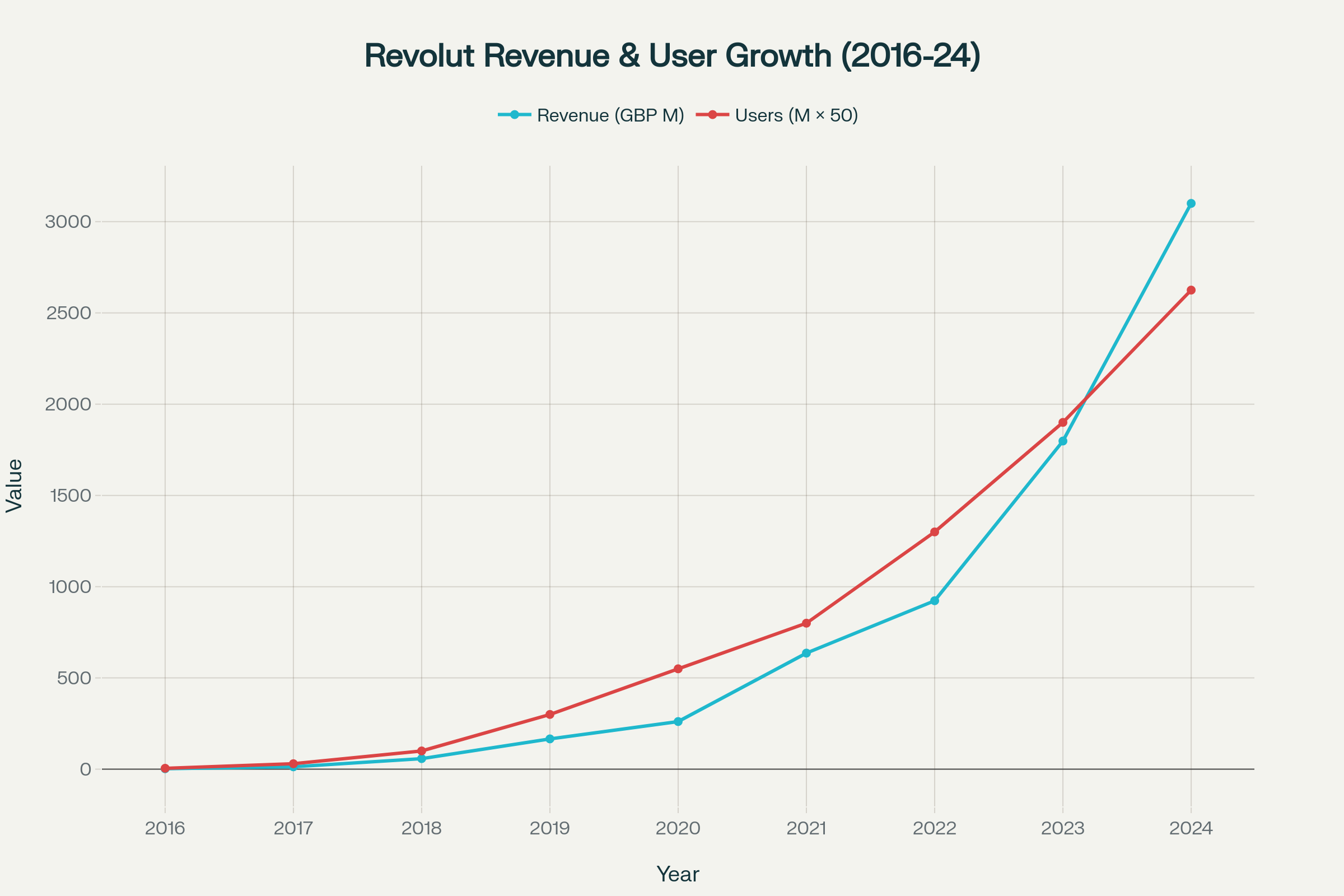
Original Business Case Weekly articleIn August 2024, Revolut achieved a $45 billion valuation cementing its position as Europe's most valuable private technology company.
This remarkable ascent from a £1.5 million seed round in 2015 to a financial services giant serving over 50 million customers worldwide represents one of the most compelling fintech success stories of the past decade.
Yet beneath the impressive growth metrics lies a complex narrative of strategic pivots, regulatory battles, cultural controversies, and the relentless pursuit of global financial services dominance. [1][2][3]

The Genesis of a Digital Banking Revolution
From Moscow to Trading Floors
Nikolay Storonsky's path to founding Revolut began in Dolgoprudny, a town 20 kilometers north of Moscow, where he was born on July 21, 1984. His father, Nikolay Mironovich Storonsky, served as deputy general director of science for Gazprom Promgaz, providing young Nikolay with early exposure to large-scale business operations. This scientific and analytical background would later influence his systematic approach to building Revolut. Storonsky excelled academically, completing a master's degree in general and applied physics at the Moscow Institute of Physics and Technology, followed by another master’s in applied economics and finance at New Economic School in Moscow.[4][5]
Moving to London in 2004, Storonsky entered the financial services industry as an equity derivatives trader at Lehman Brothers in 2006. The experience proved formative in multiple ways. He witnessed firsthand the complexity and inefficiencies of traditional banking systems while developing deep expertise in financial instruments and risk management.
When Lehman Brothers collapsed in 2008, Storonsky transitioned to Credit Suisse, where he continued trading until 2013. During this period, he accumulated substantial personal wealth—earning over $1 million through options trading—which would later fund Revolut's initial development.[6][7][4]
The catalyst for Revolut emerged from a personal frustration - huge foreign exchange fees and poor exchange rates imposed by traditional banks.
"The idea of the company came when, while travelling, he experienced the transaction fees and commissions levied by banks. His first idea was a multi-currency bank card that would allow currency conversion while traveling at a favorable rate," according to his official biography. This personal pain point would become the foundation for a global financial services empire.[4][6]
Founding team
Vlad Yatsenko, born in Germany in 1983, earned a degree in software engineering from the National University of Kyiv‑Mohyla Academy and worked at technology provider Comarch before becoming a developer at UBS, Deutsche Bank and Credit Suisse[4]. He met Storonsky in 2014 when the latter was looking for a technical co‑founder.
After discussing an idea for a multi‑currency prepaid card, Yatsenko agreed to join as co-founder and CTO and received a 20 percent stake; Storonsky contributed £300 000 of his own savings as seed capital.[8]
The founding team's approach was: systematic, data-driven, and focused on execution over perfection. "Nikolay started Revolut with a few Russian freelancers, building a product that was held together with duct tape. He knew it wouldn't last—so he eventually brought in a team to make it rock solid," observed Henrique Dubugras, co-founder of Brex.[7]
Early Product Development and Market Entry
The Initial Value Proposition
Revolut launched on July 1, 2015, with a smartphone app linked to a prepaid Mastercard. Customers could use their Revolut card in 90 countries without the fees, with honest exchange rates traditionally imposed by banks.[1]
The company targeted only one specific pain point—expensive international transactions. And provided perfect solu.
As a non-bank entity, Revolut operated as an Electronic Money Institution (EMI) under Financial Conduct Authority regulation, which limited certain services but allowed rapid market entry. This regulatory positioning enabled the company to launch quickly while avoiding the lengthy process of obtaining a full banking license—a strategic decision that would later create both opportunities and constraints.[1]
Your call
You are launching in July 2015 as an electronic-money institution rather than a bank. A prepaid multicurrency card solves foreign-exchange fees quickly but cannot yet provide insured deposits or lending. Do you keep the product narrow, seek a banking licence immediately, or add adjacent features before the core has matured? What result proves the regulatory shortcut is helping rather than postponing trust?