
NVIDIA
Making an AI empire
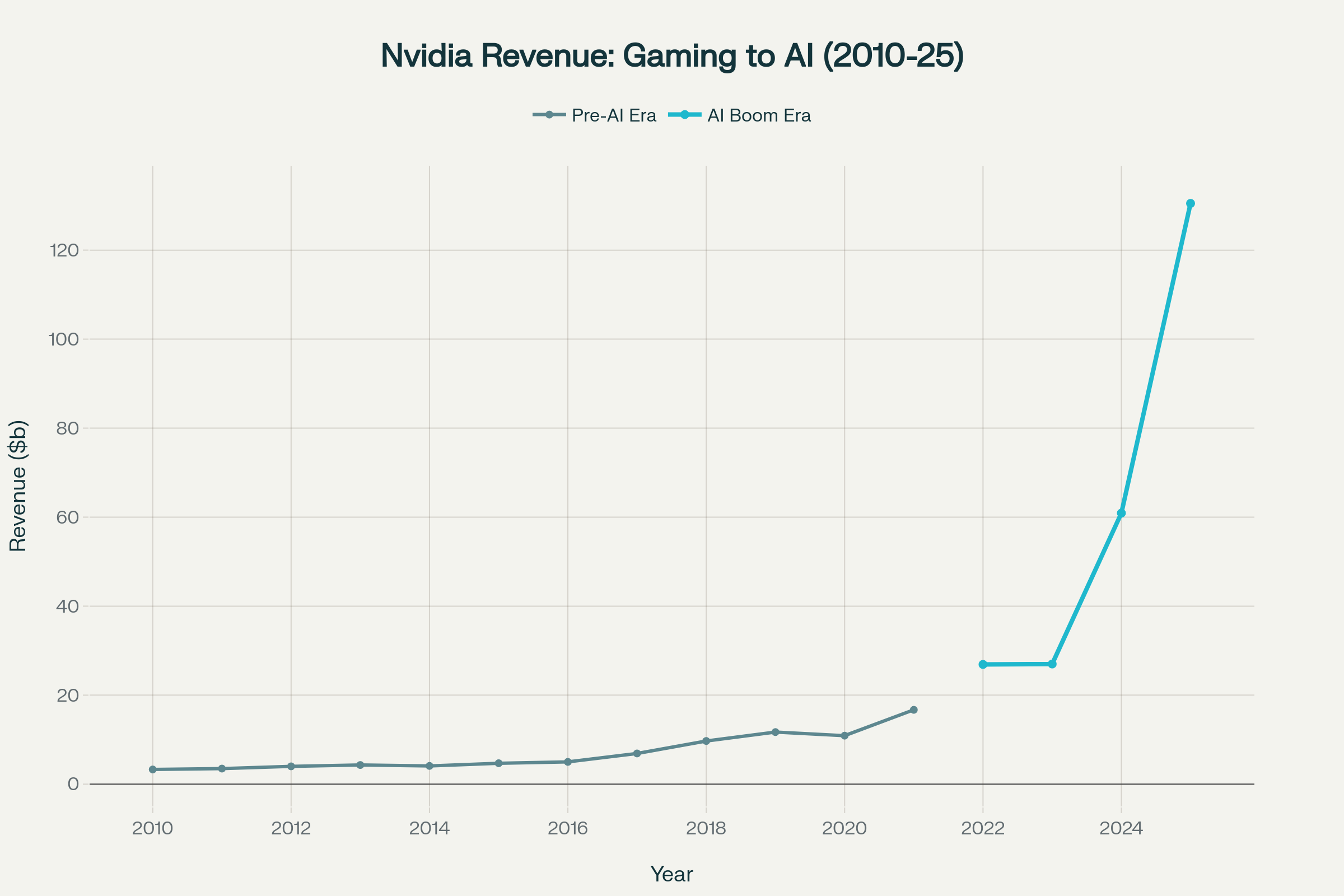
Original Business Case Weekly articleJensen Huang stood in his office in Santa Clara in 1997, staring at the latest financial reports with a familiar knot in his stomach. Nvidia had just about one month of payroll left—again. This wasn't the first time the young graphics company had teetered on the edge of extinction, and it wouldn't be the last. But what happened next would not only save the company but lay the foundation for one of the most remarkable corporate transformations in business history: from a struggling graphics card maker to the briefly the world’s most valuable company in July 2025 ($4T), powering the artificial intelligence revolution.

This is the story of how a Taiwanese immigrant who once cleaned toilets built a company that would become the beating heart of the AI age, surviving multiple near-death experiences through audacious bets, unwavering conviction, and an a rare ability to anticipate the future of computing. It's a tale of human resilience meeting technological revolution, where survival instincts forged in crisis became the strategic DNA for trillion-dollar success.
The Unlikely Beginning: From Dishwasher to Dream Builder
Jensen Huang's path to Silicon Valley began in the most unlikely circumstances. Born in Taiwan in 1963, he was sent at age nine to live with his uncle in Tacoma, Washington[1]. What his uncle believed was a prestigious boarding school turned out to be the Oneida Baptist Institute in Kentucky—a reform school for "difficult" children. There, young Jensen was forced to clean toilets daily while his brother worked on a tobacco farm. The boys faced relentless bullying, ethnic slurs, and were even threatened with knives[1].
"I remember being scared and being sad," Huang later told the BBC. "On the other hand, you are just a kid and you land in America and everything is big and beautiful and bright with amazing restaurants like McDonald's and Pizza Hut!"[2]
This harsh early experience would prove formative. It taught him always to do one's best in everything, even sports[2]. The lesson was simple but profound: when you're already at the bottom, the only direction is up, and you better give everything you have to get there.
After his family reunited in Oregon, Huang excelled academically while working multiple jobs—from dishwasher at Denny's to various odd jobs that funded his education[1]. He graduated from Oregon State University with a degree in electrical engineering in 1984, then earned his master's from Stanford University while working at Advanced Micro Devices and later LSI Logic Corporation[1][3].
But it was a meeting at a Denny's restaurant in 1993 that would change everything. Three engineers—Huang, Chris Malachowsky from Sun Microsystems, and Curtis Priem from IBM—gathered to discuss their shared vision of the future of computing[4]. They believed that graphics-based processing could tackle challenges that general-purpose computing methods couldn't solve[4].
"We also observed that video games were simultaneously one of the most computationally challenging problems and would have incredibly high sales volume. Those two conditions don't happen very often. Video games was our killer app—a flywheel to reach large markets funding huge R&D to solve massive computational problems"
With $40,000 in the bank and $20 million in venture capital from Sequoia Capital and others, Nvidia was born[4]. But the company that would eventually become worth over $4 trillion started with a name crisis. The founders couldn't create a workable name with syllables from all three surnames, after considering "Huaprimal," "Prihuamal," and "Malluapri." They eventually settled on "Nvidia" from "invidia," the Latin word for "envy"[4].
The First Near-Death Experience: NV1 and the Wrong Bet
Nvidia's first product, the NV1, launched in 1995, was technically ambitious but commercially disastrous[4]. While other companies focused on triangular polygon rendering, Nvidia bet on quadratic texture mapping—a completely different approach that rendered curves instead of triangles[5]. The company believed this would provide superior graphics quality and avoid the need for expensive Z-buffers.
"NV1 and NV2 were based on forward texture mapping, no triangles but curves, and tessellated the curves. Because we were rendering higher-level objects, we essentially avoided using Z buffers. We thought that that was going to be a good rendering approach, and turns out to have been completely the wrong answer"
The NV1 was expensive, didn't offer competitive sound quality, and crucially, no games actually supported it except those bundled with the card[6]. Meanwhile, the PC gaming industry was rapidly standardizing around Microsoft's DirectX, which used triangle-based rendering—exactly the opposite of Nvidia's approach[5].
Nvidia was bleeding money and facing an existential crisis. The company had spent enormous resources developing technology that the market was rejecting. Worse, Microsoft's launch of DirectX showed that the industry was moving in a completely different direction[5]. Thirty competitors had emerged in the 3D graphics space, and Nvidia was now behind with incompatible technology[5].
Your call
You are Nvidia’s chief architect after Microsoft standardises DirectX around triangles while your NV1 uses quadratic surfaces. Continuing may protect years of work and leave the company outside the emerging standard; changing architecture means admitting the core bet was wrong with little cash left. When do you pivot, what do you salvage, and which market signal makes the decision irreversible?