Ryanair
A case study in knowing which refusals to keep
Original Business Case Weekly articleExecutive Summary
Ryanair carried 208.4 million passengers in the year to March 2026, more than any other airline in Europe, and made a record €2.26 billion of profit after tax [1]. That is about $2.6 billion at $1.15 to the euro; older figures in this case are converted at the rates of their time. Excluding fuel, Ryanair spent €36 to fly each passenger that year. By its own estimate, the equivalent cost was €90 at easyJet, Britain's largest low-cost airline, and €178 at Lufthansa [2].
Ryanair got there by refusing things other airlines took for granted: business class, free bags, travel agents, trade unions, full airport charges and anything near the list price for aircraft. Each refusal cut a cost, and each carried a charge that the accounts do not show, paid in the goodwill of passengers, the loyalty of pilots or the patience of regulators. For 40 years Ryanair has had to decide which of its refusals made it cheap and which were only habit.
In October 2026 Ryanair has no debt. Wizz Air, its nearest low-cost competitor, made a net profit of only €1.3 million in its year to March 2026. Since February a war involving Iran has made jet fuel 50 per cent dearer than crude oil, against a usual gap of 10 to 15 per cent. Ryanair has fixed the price of 80 per cent of its fuel for the year to March 2027, but of only 15 per cent for the following year, which includes the summer of 2027. It must decide how many seats to offer that summer: more, to take passengers from weaker rivals, or fewer, to limit how much fuel it buys at whatever the price then is.
Close It Down, 1985-1991
In the early summer of 1988 Michael O'Leary, a 27-year-old accountant, drove with Declan Ryan to County Tipperary to see Declan's father, Tony Ryan. O'Leary had worked for Tony Ryan for less than a month, as his personal assistant, and his job was to stop Ryanair, the family's small airline, from losing money [3]. He had come to say that it could not be done.
No one had a handle on the finances and money was leaking out all over the place. All Ryanair was doing was cutting 20 per cent off the fares charged by Aer Lingus and British Airways and losing loads of money.
Michael O'Leary, recalling 1988, in Alan Ruddock, Michael O'Leary: A Life in Full Flight (2007) [3]
His advice, which Declan shared, was to close the airline. Tony Ryan refused and told them to sort it out [3].
Tony Ryan had made his fortune at Guinness Peat Aviation, which he founded in 1975 to lease jets to airlines [3]. In 1984 Aer Lingus, Ireland's state-owned national airline, had undercut a small private rival, Avair, out of business. Wanting a newcomer rich enough to survive the same treatment, the Irish government in 1985 licensed Ryanair, which Tony Ryan's family owned through a trust, to fly from Waterford, in south-east Ireland, to London Gatwick [3]. All the pound figures in this section are Irish pounds.
The route that mattered opened in 1986, from Dublin to London Luton. Until then only Aer Lingus and British Airways had flown between Dublin and London [4]. In the run-up the two incumbents cut their cheapest return fare to £95, and Ryanair launched at £94.99 [3].
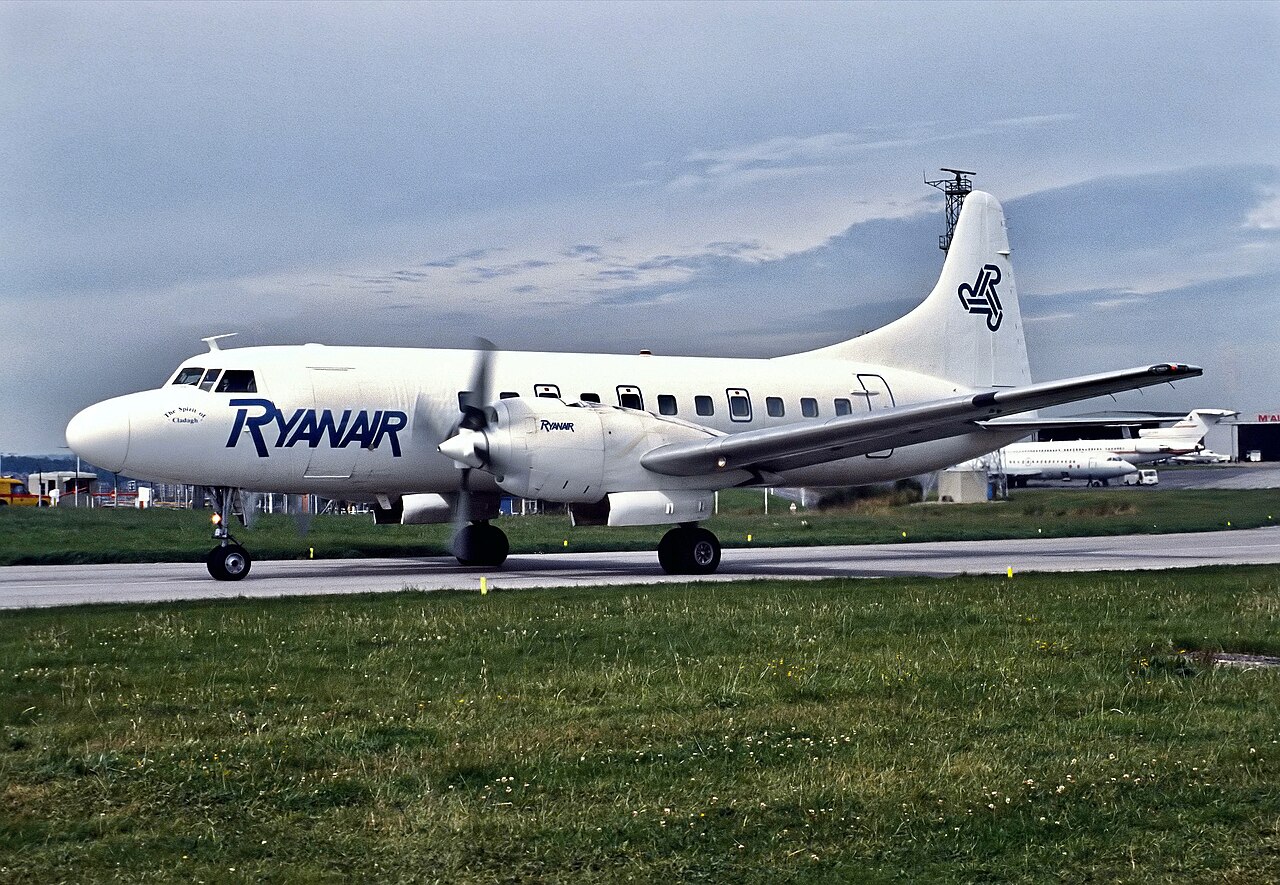
Ryanair filled its aircraft but made no money, because its costs were too high. It flew several types of aircraft, each needing its own spare parts and trained crews, and opened routes wherever it could get a licence. At the end of 1986 the family bought London European Airways, a failing airline at Luton, and relaunched it as Ryanair Europe, offering a full service for a third of the price British Airways charged. It lost heavily and gave up its scheduled flights in January 1989 [3].
In August 1989 Tony Ryan, O'Leary, by then a director of Ryanair, and P.J. McGoldrick, its chief executive, told Seamus Brennan, Ireland's transport minister, that Ryanair would close unless Aer Lingus stopped competing on its routes to London. By then Ryanair also flew from Dublin to Stansted, an airport north-east of London. Brennan divided Dublin's London routes between the two Irish airlines: Aer Lingus kept Heathrow and Gatwick and left Stansted and Luton to Ryanair [3][4].
Tony Ryan put in more money, and the airline cut routes and jobs and lowered pilots' pay. In 1991 it carried 650,000 passengers and reported a profit of £293,000, but only because it had sold a stake in a hotel and tourism business [3]. Since 1985 it had lost more than £20 million [3].
At the end of 1991 McGoldrick resigned, and Ryanair needed its fifth chief executive in six years. Friends of Tony Ryan said that he had reached the end of the line: if the airline could not survive without more of his money, he would sell it if he could find a buyer and close it if he could not [3].
He had three choices. The first was to get out: close the airline, as O'Leary had advised in 1988, or sell it. The second was to keep it as a small conventional airline with fares somewhat below Aer Lingus's, following the plan McGoldrick left behind: buy new Airbus jets and earn extra money from charter flights and from flying routes for larger airlines under contract [3]. The third was to copy Southwest Airlines of Texas, which flew one type of aircraft, the Boeing 737, from uncongested airports such as Love Field in Dallas. Southwest turned its aircraft round in less than 30 minutes, where other airlines took 90, so each aircraft flew more trips a day; it did not assign seats, which helped keep turnarounds short. In 1991, a year in which high oil prices caused heavy losses at most airlines, it made a profit of $26.9 million [3].
The case for staying conventional looked stronger. The European Community, the forerunner of the EU, was negotiating rules to open its skies, but they would take effect only in stages from 1993. Until then fares needed government approval, and an Irish airline could fly only between Ireland and other member states. Southwest's model also depended on America's deregulation of 1978, which let an airline fly wherever it liked, as often as it liked. Aer Lingus could afford losses for as long as the state would cover them. The 1989 split gave Ryanair two London airports where Aer Lingus would not compete. Ryanair Europe had shown how quickly low fares could lose money. With routes, jobs and pay already cut, a conventional airline with a protected niche at Stansted and Luton looked the safer way to stop the losses.
Your call
It is December 1991 and you are Tony Ryan. Ryanair has lost more than IR£20 million (more than $30 million) since 1985, its chief executive has just resigned, and you will put in no more of your own money, so any plan to keep flying must be paid for by the airline. The government has barred Aer Lingus, the state-owned national airline, from your routes between Dublin and London's Stansted and Luton airports. But Aer Lingus has already driven one newcomer out of business by pricing below it, and European rules freeing fares and routes arrive only in stages from 1993. You can sell the airline, if a buyer can be found, or close it. You can keep it as a conventional airline with fares a little below Aer Lingus's, earning extra from charters and from flying routes for larger airlines. Or you can rebuild it around the lowest possible fares, one type of aircraft and fast turnarounds, as Southwest Airlines has done in America, where airlines may fly any route at any fare. Choose, say what must be true about travellers between Ireland and Britain for your choice to work and, if you keep flying, name the result after a year that would justify carrying on.