Palantir
A case study in strategic refusal. Lose money for Seventeen Years, but finally reach profitability and valuation — $327 billion.
Original Business Case Weekly articleThis morning I saw a headline that the UK is reopening its review of Palantir’s £330 million NHS data contract, and the stock slid again [1].
My first thought was that this company has been publicly accused of roughly everything short of controlling the weather since 2003, and it keeps compounding anyway.
I run a B2B company and spend a large share of my time on one question, how to make AI actually do work inside messy operational data, and Palantir is the only software business whose entire 23-year history is one continuous argument about exactly that question.
Everything strange about it, the forward-deployed engineers, the refusal to hire salespeople, the CIA seed money, the CEO who calls his own privacy architecture Hegelian, turns out to be a position in that argument.
For seventeen of those years the position lost money. Then it produced what its CEO plausibly calls the fastest-growing software business in history at this scale, trading at roughly 43 times forward revenue [2][3].
I wanted to understand whether the refusals were the moat or just survived in spite of themselves. This case is my attempt to find out.
A Doodle on Sand Hill Road, 2003-2008
In 2004, Alex Karp sat in a pitch meeting at Sequoia Capital, the most influential venture firm in Silicon Valley, watching Michael Moritz, Sequoia’s best-known partner, a PayPal board member close to Peter Thiel, spend most of the meeting absentmindedly doodling in his notepad [4]. Sequoia passed, as had essentially every other firm Karp’s team visited. Karp said nothing in the room. He carried the moment for years.
I should have told him to go fuck himself.
Alex Karp on Michael Moritz, quoted in Michael Steinberger, “The Philosopher in the Valley,” Fast Company excerpt, November 2025 [4]
The company being rejected had been incorporated in May 2003 by Peter Thiel, fresh from selling PayPal, who believed that better data analysis could have prevented the September 11 attacks [5][6]. Thiel recruited Nathan Gettings, a PayPal engineer who had worked on the fraud-detection systems that saved that business, plus two Stanford students, Joe Lonsdale and Stephen Cohen, to build a prototype [6].
For CEO he chose Alex Karp, a Stanford Law School classmate with a PhD in neoclassical social theory from Goethe University in Frankfurt, no engineering background, and no startup experience [6]. Thiel named the company after the seeing stones in Tolkien’s Lord of the Rings and, when venture capital refused to fund it, largely bankrolled the roughly $30 million startup cost from his own pocket and his fund [5].
The Sand Hill Road consensus was not irrational. Selling software to the US government meant multi-year procurement cycles, security clearances, and a customer famous for preferring custom systems from defense primes. The rational advice in 2004 was to take PayPal’s fraud-detection pedigree and sell it to banks, where buying cycles were measured in quarters and the team had referenceable wins. Industry observers at the time would likely have recommended exactly that path, and the universal VC rejection suggests most of them did. Thiel and Karp refused, because the company existed for the government mission, and a bank-fraud product would have been a different company.
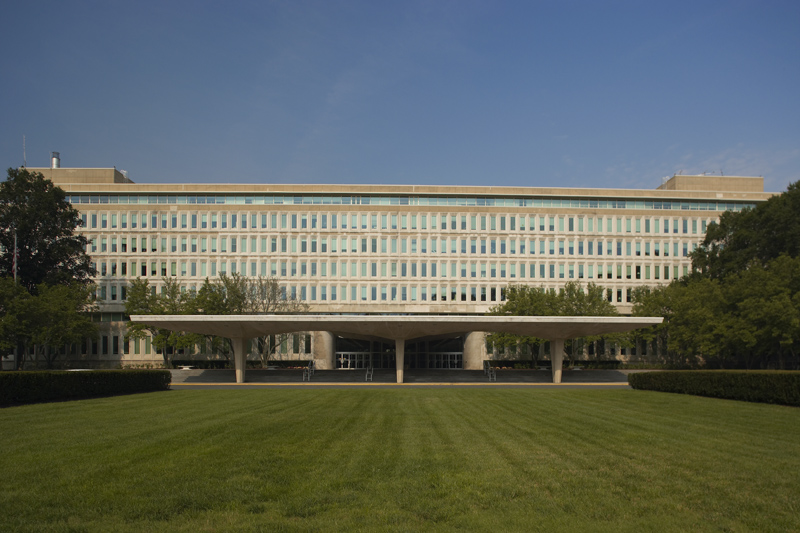
One pitch meeting changed the trajectory. A partner who declined to invest suggested Palantir approach In-Q-Tel, the venture arm the CIA had created in 1999 [4]. In-Q-Tel CEO Gilman Louie, a former video game designer recruited by CIA Director George Tenet, normally skipped pitch meetings but attended because Thiel was involved [4]. The CIA happened to be unhappy with Analyst’s Notebook, its incumbent analysis tool, and Louie watched the Palantir team drop out of sales mode mid-meeting and start engineering solutions in front of him. He sent them home with an assignment, design an interface intelligence analysts would actually want. Cohen, then 22 years old, and Gettings sequestered themselves and built the demo [4].
If Palantir doesn’t work, you guys have a bright future designing video games.
Gilman Louie, CEO of In-Q-Tel, on seeing the demo, quoted in Steinberger [4]
In-Q-Tel invested $1.25 million; Thiel added another $2.84 million [4]. The money mattered less than the access. Louie embedded Palantir engineers with CIA analysts at the terrorism finance desk, reasoning that software this ambitious could only be built by watching the workflow it had to serve [4]. Starting in 2005, Cohen and engineer Aki Jain flew from Palo Alto to Langley every two weeks, roughly two hundred trips in total, carrying the latest build, collecting feedback, returning to fix it. Analysts nicknamed Cohen “Two Weeks” [4]. This shuttle run invented the role Palantir later formalized as the forward-deployed engineer, arguably as essential to the company’s eventual success as the software itself [4]. From 2005 to 2008 the CIA was Palantir’s sole patron and alpha customer [7].
Karp, who refused to obtain a security clearance, contributed something else. He insisted the engineers build civil-liberties guardrails directly into the product, access controls limiting users to authorized data and an audit trail recording every attempt to reach beyond it [4].
It is the ultimate Silicon Valley solution: you remove the contradiction, and we all march forward.
Alex Karp describing the privacy architecture to Charlie Rose, 2009, quoted in Steinberger [4]
It took roughly three years, several near-death moments, and money that periodically ran short before Gotham, the first platform, was marketable [4]. Even then, CIA analysts were not obliged to use it, and some who tried it were underwhelmed. The breakthrough came through a single internal evangelist, analyst Sarah Adams, who saw a demo at a Bay Area conference in late 2006, ran a pilot, and found the software made her counterterrorism work dramatically faster [4]. Her advocacy was instrumental in Palantir’s first CIA contract, and the pattern, one internal convert who proselytizes until a deal closes, would repeat across deployments for the next two decades [4].
Your call
You are Joe Lonsdale in late 2004. Sequoia and every other top-tier firm have passed. Thiel is willing to keep funding the government thesis, but a fintech pivot would get term sheets within a quarter and you have referenceable PayPal fraud technology. Do you take the pivot, and what evidence about the government market would change your mind?