
SEGA
Paradox of being right too early
Original Business Case Weekly articleSEGA’s story is not a rise-and-fall narrative. It is a study in how a company can simultaneously hold the best strategic position in its industry and destroy it through internal conflict.
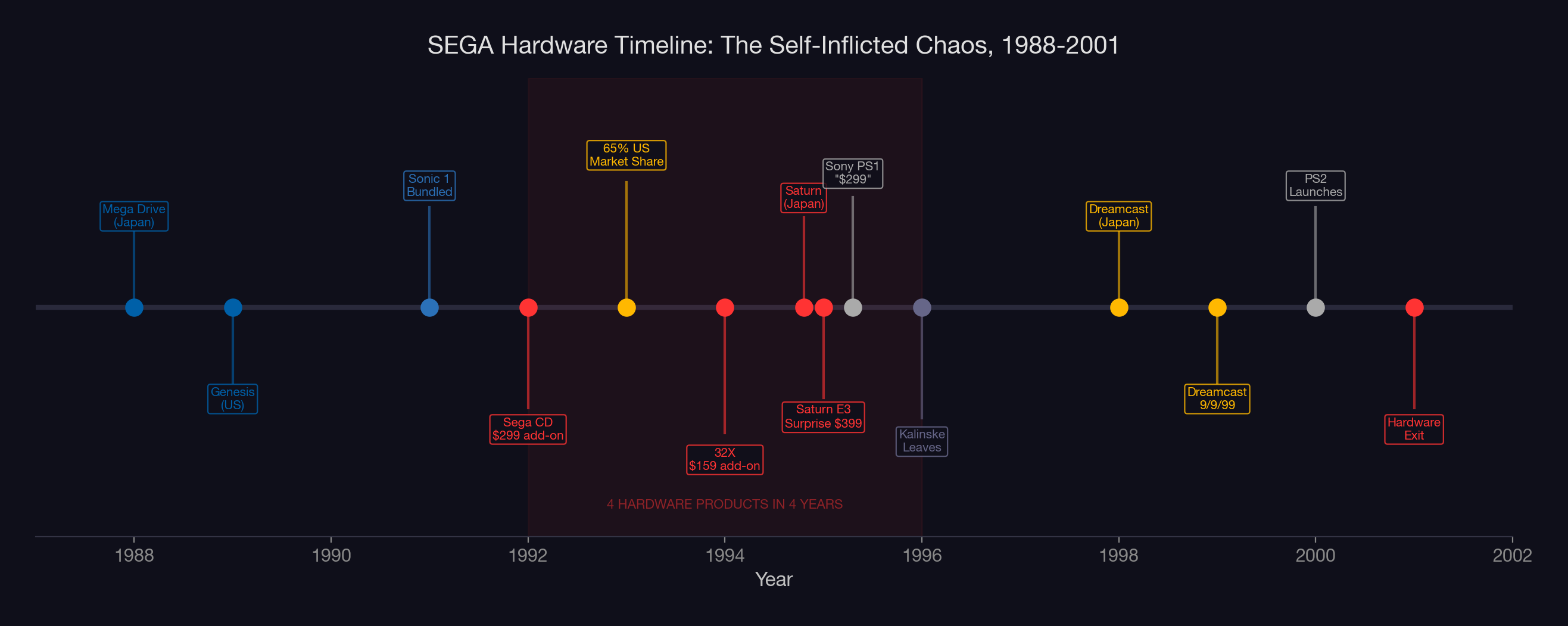
Between 1990 and 2001, SEGA went from 5% of the US console market to 65%, back to zero, and then reinvented itself as something entirely different. The decisions that killed SEGA’s hardware business were not made by competitors. They were made by SEGA’s own executives, fighting each other across the Pacific Ocean. That pattern of brilliant local execution undermined by fractured global leadership is what makes this case worth studying.

An Airman’s Side Hustle in Occupied Japan, 1951-1965
David Rosen was a 21-year-old US Air Force serviceman stationed in Japan when he noticed something. Japanese civilians needed identification photographs for a growing number of government-issued cards, and there were not enough photo studios to meet demand. In 1952, after his service ended, Rosen founded Rosen Enterprises and began importing coin-operated photo booths from the United States. He placed them in department stores, train stations, and restaurants across Tokyo.
The photo booth business was profitable but small. Rosen kept watching what Japanese consumers fed coins into. By 1957, he obtained a special license from Japan’s Ministry of International Trade and Industry to import American coin-operated amusement machines. The timing was precise. Japan’s post-war economy was accelerating, disposable income was rising, and entertainment options were scarce.
Right from the start, the machines were phenomenally successful. I was opening arcades all over Japan, and we were lucky.
David Rosen, recalled in a 1996 interview [1]
Your call
If you are David Rosen in 1965, you have a choice: continue importing American machines with proven demand, or invest in manufacturing original games with uncertain appeal. The factory conversion costs real money. What evidence would you need to justify the risk of original game development versus the safety of distribution?