
Tether
Original Business Case Weekly articleHow to build a business with a 99% profit margin, the highest in the world?
This is a case study about Tether.

Introduction
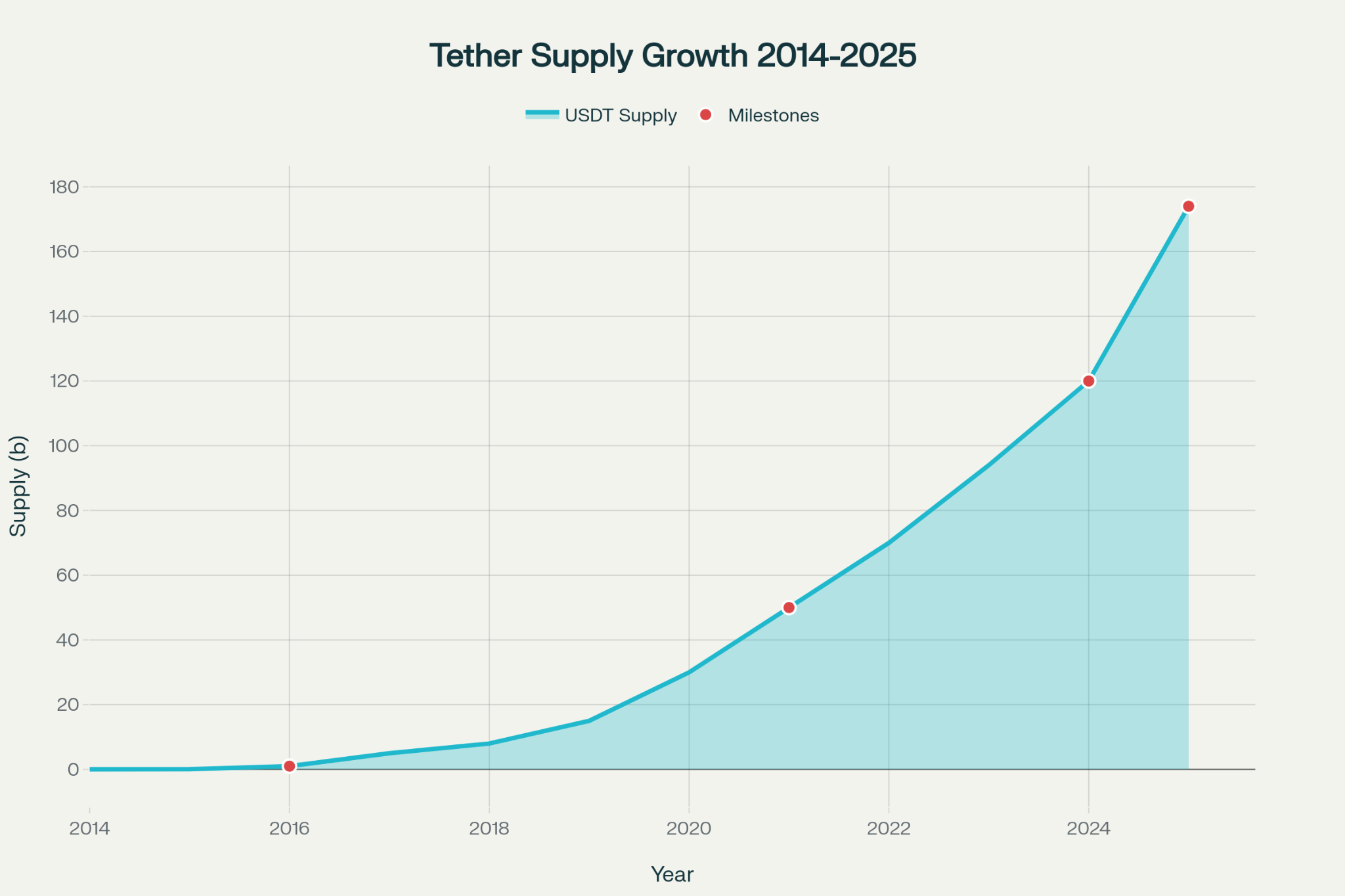
Tether, launched in 2014, achieved scale and became the largest stablecoin by claiming each token was backed by a U.S. dollar reserve.

Stablecoin’s primary purpose is to act as a reliable medium of exchange and a bridge between the volatile crypto world and traditional finance, solving the extreme price fluctuation problem of other cryptocurrencies like Bitcoin. Also a token pegged 1‑to‑1 with fiat (real money) was meant to provide seamless on‑ramp and off‑ramp between conventional money and digital assets.
This case study traces Tether from its inception through October 2025. It examines leadership decisions, regulatory battles, expansion into emerging technologies and cross‑industry parallels.
Birth of a “digital dollar” (2014–2015)
In 2014 the crypto market was immature and volatile. That year, cryptocurrency exchanges, including Bitfinex, were looking for reliable liquidity but “altcoins” were associated with speculation.
The founders of Realcoin – Brock Pierce, Reeve Collins and Craig Sellars – recognised that traders needed a crypto‑native asset that behaved like traditional currency. They launched Realcoin on the Omni protocol on top of Bitcoin and pegged each token to one U.S. dollar held in reserve.
Realcoin’s promoters decided to detach from the altcoin stigma by rebranding. On 20 November 2014 co‑founder Reeve Collins announced that Realcoin would be renamed Tether. He stressed that the project was not an altcoin but a service: Tether would “issue tokens that represent dollars” and “create and destroy” tokens on the fly to match deposits and withdrawals. Collins said the name change was meant to clarify that Tether was a digital tie to real‑world assets rather than a speculative coin[1]. Later he and his partners secured partnerships with Bitfinex, Expresscoin, GoCoin and ZenBox[1].
By early 2015 the token supply remained small (around $1 million). But adoption grew because exchanges could now settle trades denominated in dollars without maintaining actual bank accounts.
In 2015 Tether’s founders later sold control of the project to Bitfinex executives Giancarlo Devasini (CFO), Phil Potter (CSO) and Jan Ludovicus van der Velde (CEO). Their influence would shape future choices. The basic architecture – one token per dollar on deposit – set expectations for backing on Tether that later will be tested multiple times.
Your call
You are launching Realcoin in 2014. Calling each token a digital dollar and promising one-to-one reserves makes the product legible to exchanges, while creating a standard that can be disproved at any moment. Do you make the full-reserve claim, describe a broader pool of liquid assets, or delay until banking is secure? What disclosure accompanies the promise?